Project beneficiaries:
Total 9539 beneficiary (Beekeepers: 744, Mouals: 95 and Honey Crop Producers: 8700)
Goal & Objectives of the Project:
Goal
To increase income and improve livelihood of Beekeepers and Honey Crop Producers through honey production following modern and scientific technology and marketing.
Objectives
- Increase productivity and reduce production costs by improving farmers' skills in the use of different technologies in the production and collection of honey and honey products.
- Raising consumer awareness about the beneficial aspects/qualities of honey and honey products as well as contributing to increase the demand for honey and honey products.
- Increase the supply of pure honey and increase the sale of honey through marketing.
Background:
Honey is one on the cash crop in Bangladesh produces (3,500-4,000MT) plus annually which 0.19 percent of the world’s total production is. Honey provides good nutrition, medicinal values to the consumers and significant income of the beekeeper. Honey bee is God gifted beneficial insect which playing substantial contribution in agriculture such as pollination agent, and environmental bio- indicators. Honey sector playing a significant role in food security, nutrition development and climate conservation worldwide. Honey bees are a significant economic resource as commercial producers of bee products. Although Bangladesh has a favorable ecological condition for beekeeping, only a fraction of its potential is being utilized. In Bangladesh, beekeeping is one of the age-old traditions that started more than 400 years ago (Sivaram, 2012). Back then, the crude practices of honey hunting using natural methods were prevalent which saw the destruction of beehives resulting in the death of the entire bee colonies. Nowadays some instances of such methods can still be found in some areas of the country (Moniruzzaman & Rahman, 2009). Despite its long history, beekeeping in Bangladesh is still an undeveloped sector of agriculture. The knowledge and skill of honey production and honey and beeswax extraction of Bangladesh beekeepers is still very traditional. In many regions of the country, apiculture is considered as one of the income-generating activities for resource-poor farmers including women, youth and the unemployed sectors of the community. Apiculture also provides attractive options for rural employment and income generation in harsh agro-ecosystems where crop production is marginal and the risk of crop failure is high. There is a great potential in the country for working with communities by introducing minor and easily adaptable apiculture production system, leading to considerable gains in productivity beyond family consumption needs. The potential for improvement of the traditional honey and wax production has led to apiculture promotion as part of policy initiatives taken by the government of Ethiopia although they have been, in the past, defeated by the impact of major constraints and lack of appropriate research.
Low productivity and poor quality of bee products are the major economic impediments for rural beekeepers; however, they face another primary economic concern: lack of skill to manage their bees and bee products. Most of the rural beekeepers cannot afford to invest in inputs, process, pack, and transport their products to market to maximize profit. Increase Income and Livelihood Development of Beekeepers through Sustainable Beekeeping Development and Bee Product Marketing is a subproject of Promoting Agricultural Commercialization and Enterprises, (PACE). PACE is a project of Palli Karma-Sahayak Foundation (PKSF) supported by IFAD for a period of July 2016 to June 2022. This project is implementing BASA Foundation a national NGO in Bangladesh. Total 9539 beneficiary (Beekeepers: 744, Mouals: 95 and Honey Crop Producers: 8700) are receiving technical, technologies and marketing support under this subproject. The project has been implementing in 24 Upazilas of Tangail, Narayanganj, Sirajganj, Gazipur, Khulna and Khagrachari, Rangamati, Bandarban hill districts. The sub-project aims to capacitate beekeepers to produce good honey, employment generation, and overall income from the honey business.
Major activities:
- Conduct Baseline survey
- Skill development training on advanced beekeeping
- Provided 12-days training for 10 entrepreneurs on running small-scale honey processing centers
- Advanced training on beekeeping by foreign volunteer.
- Conduct research on pollination by bee.
- Honey Crop Producers training on the role of bees in increasing crop production and benefits of consuming honey.
- Preparation and distribution of annual honey production plan charts.
- Organized discussion meetings with exporting companies.
- Organized workshops on safe honey production, marketing and increasing honey crop cultivation at the upazila and national levels.
- Organized expouser visit for beekeepers.
- Refreshers training on advanced beekeeping
- Organized residential training on pollen and royal jelly collection and preservation for 20 advanced beekeepers.
- Distribution of pollen traps and pollen recipes among beekeepers for bee’s dearth period management.
- Beekeeping equipment distribution among beekeepers.
- Establishment of improved bee queen production center.
- Establishment of laboratories and information centers.
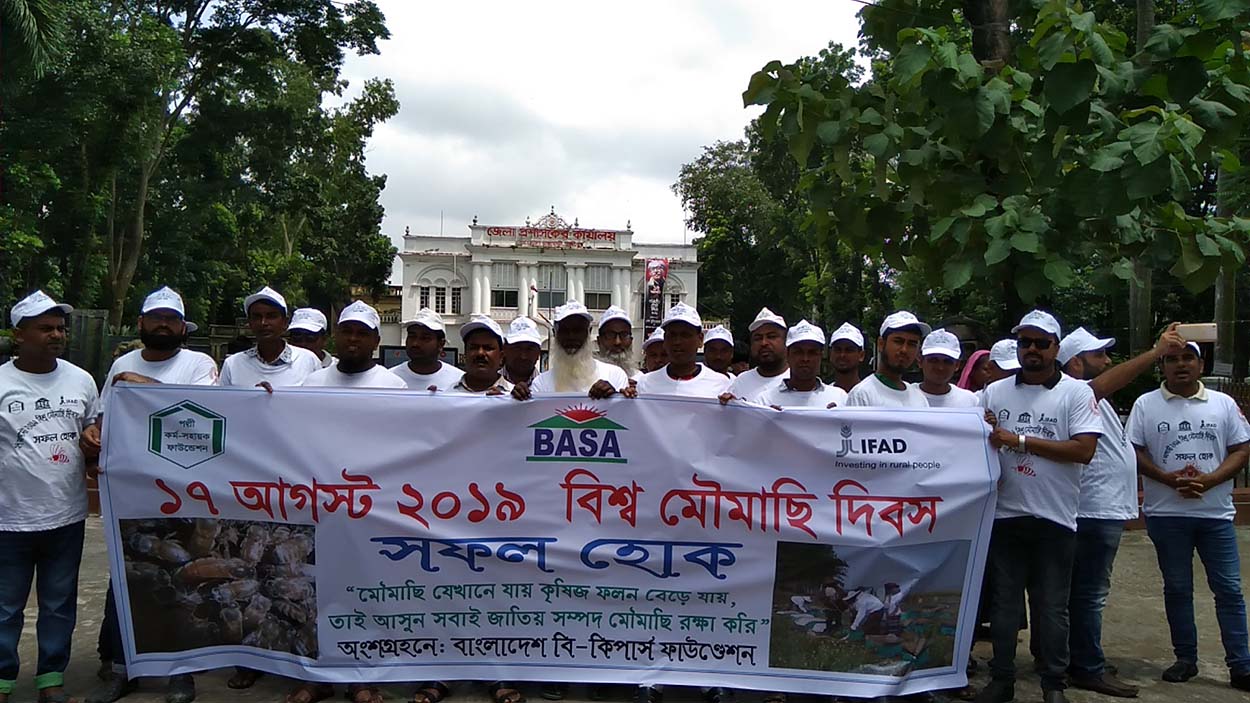
- Celebration of various bee days.
- Conducting campaign on the benefits of honey consumption at the school level.
- Prepared video documentary on the beekeeping sector.
- Prepared communication materials and distribution.
- Initiative taken to sell honey through e-commerce.
- E-commerce website developed to increase honey sales. (www.aadibazaronline.com.bd )
- Conduct impact evaluation.
-
Donar Name:
Palli Karma-Shahayok Foundation (PKSF), International Fund for Agriculture Development (IFAD)
-
Date:
June 2022 to 16 August 2026
-
Category:
Apiculture(Beekeeping)
-
Location:
24 Upazilas of Tangail, Narayanganj, Sirajganj, Gazipur, Khulna and Khagrachari, Rangamati, Bandarban hill districts.
